Athlete Success Case Study: Kamaria McDaniel Heals at Chiron
· Heather Ohanaja, Michelle Cohl
Playing through pain kept Kamaria McDaniel on the court—but left important questions unanswered. At Chiron, the professional basketball player found a clearer path forward through physician-led care, objective testing, and her personalized Athlete Blueprint.
Inkster native Kamaria McDaniel has taken her basketball journey to many places.
The 27-year-old played high school basketball at Dearborn Heights Robichaud and Detroit Country Day before competing at Penn State, Baylor, and Michigan State.
Her professional career has included stops in China, Turkey, and Puerto Rico, as well as time in WNBA’s developmental Upshot League and training camp contracts with the Washington Mystics and the Las Vegas Aces.
And across the many different uniforms, locations, coaches and teammates, two things have remained constant for Kamaria: Her determination to keep playing at the highest level possible, and the physical toll that basketball has taken on her body.
“The game is brutal,” Kamaria said. “It’s more brutal than it looks.”
A player is running and jumping repeatedly on hardwood floors while absorbing contact, cutting, landing, pushing, pulling and falling.
And then there’s the schedule.
“You take a beating for almost two hours, then you travel to another city,” Kamaria said. “You have one day of recovery and then you do it again.”
Practices involve several miles of running while strength and conditioning work happens on top of all that. And for a fast, explosive guard like Kamaria, the demands accumulate quickly.
Like many high-level athletes, Kamaria has a high pain tolerance. For years that helped her compete. But being able to tolerate pain is not the same as solving a problem, which Kamaria learned firsthand.
The scars on both her knees offer visible evidence of that battle.
Knee injuries in 2015 and 2020 – the latter involving a complete meniscus tear – became part of an injury history that would eventually include Achilles tendonitis in both legs. And yet, Kamaria kept going. Because that’s what elite athletes do.
The problem was that, eventually, just pushing through was no longer getting her to where she wanted to go.
Kamaria had spent years learning her body through injuries, rehabilitation, and high-level training. She was no stranger to communicating with physicians and therapists about what she was feeling.
What she didn’t have was Chiron's Athlete Blueprint. The complete, objective picture of why these problems continued to interfere with her ability to play ball – or what needed to change to get her to where she wanted to be.
Her introduction to Chiron Sports Performance happened almost by chance. But what began as a chance encounter quickly became something more when Kamaria realized that their team could give her the level of testing and objective feedback she hadn’t experienced before.
In a positive turn of events, Kamaria is now embracing the most eye-opening and hope-inspiring experience of her lifelong basketball journey.
A Different Way Forward
Kamaria wasn’t actively searching for a new performance or recovery program when she first encountered Chiron.
She attended a basketball event where her Achilles problems kept her from participating. While she was there, a longtime basketball friend introduced her to Heather Ohanaja, co-founder of Chiron Sports Performance.
As they spoke, Kamaria shared what she had been dealing with physically. And Heather quickly realized this was a conversation that her husband, Chiron lead physician and co-founder Dr. Chibuzo Casey Ohanaja (also known as Dr. Oh), needed to join.
That conversation became the beginning of something much more comprehensive than what Kamaria had expected after attending the event.
This was early in 2026, and it’s when she first realized what an exceptional resource was available to her right here in Metro Detroit.
Chiron would become more than a place of treatment for her knees. It would be a full-scale analysis and assessment of her physiology to determine what could be strengthened, what adjustments she could make, and the type of game plan that would not only get her to full health but allow her to maintain that level of health while performing at her highest level on the basketball court.
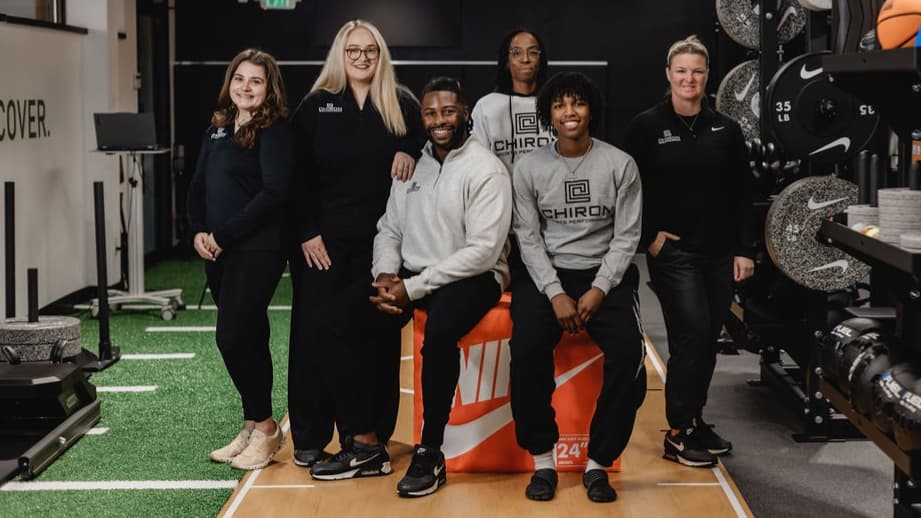
And it was all with the support of a team led by a sports physician who is a former athlete himself.
“They’re very easy to talk to,” Kamaria said. “They’re personable. It’s a different experience, just very articulate and helping you understand what’s going on – trying to center things around you so you feel catered to.”
Initially, the focus was on her Achilles tendonitis.
“When I came here, we started getting the Achilles thing under control,” Kamaria said. “We were doing Shockwave Therapy recovery. I would do a basketball workout, do the conditioning workout, and then come here and do recovery.”
That treatment made a significant difference. Kamaria says her Achilles symptoms improved to the point that she no longer had to walk downstairs sideways because of the pain.
But once she started working out more aggressively again, another issue emerged. Her knee was swelling significantly.
“I couldn’t catch a break,” she said.
With Dr. Oh’s assistance, an MRI revealed high-grade cartilage damage along with changes involving the meniscus and years of accumulated wear and tear.
But Kamaria still had dreams. She has professional aspirations.
She wanted to train and she wanted to get back on the court.
But her knee was increasingly interfering with her ability to do either. And that’s when the focus shifted from treating individual symptoms to developing a larger plan around her entire body.
Measuring the Improvement | Looking Beyond What Hurts
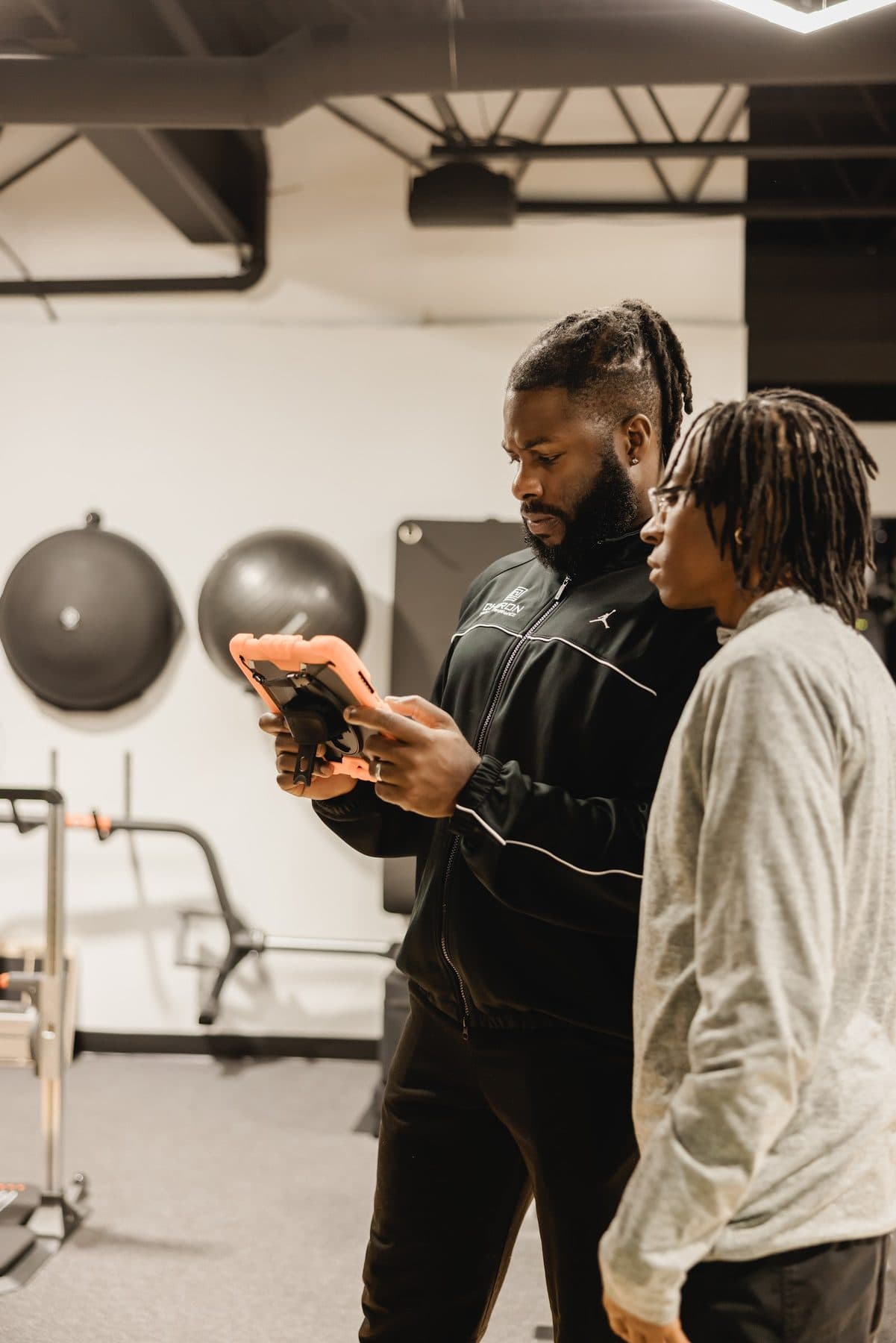
Through Chiron’s Athlete Blueprint and performance testing, the team began looking at more than Kamaria’s knee.
They examined how she moved, how her right and left sides functioned, how her muscles were responding to training and recovery, and where deficiencies could be contributing to the issues she was experiencing.
One of the things Kamaria realized was that her own high pain threshold was working against her. That threshold encouraged her to subject her joints and tissues to the impact that was causing damage. And surprisingly enough, one of the findings was that Kamaria had been using different movement strategies on her right and left sides.
“I didn’t even know you could look at stuff like that,” Kamaria said.
With Kamaria’s hips not contributing the way they should, other areas like her quads and knees ended up taking on more of the load. So rather than focusing on the painful joint, the Chiron team worked through the chain piece by piece.
When she first came to Chiron, she could hardly do squats. She was also unable to perform some of the single and double-leg jumping tests in the Performance Lab. But her Athlete Blueprint and body composition analysis showed just where she needed to build strength at a cellular level, so the Chiron team put together a plan to address those issues.
And according to Dr. Oh, updated testing showed improvements in Kamaria’s cellular health, tissue strength, and resilience.
“Her cellular integrity and strength have gone up, so the cells in her body are getting more resilient against injury and inflammation,” Dr. Oh said. “It’s also an indication of her muscle tissue getting stronger.”
The testing also showed that Kamaria had gained close to a pound of muscle mass in her left leg – the side that had been giving her problems.
Chiron also saw changes in her cellular fluid distribution within the leg that indicates healthier muscle tissue and improving inflammation.
“We really are assured she is heading in the right direction,” Dr. Oh says.
The performance data supports that conclusion.
“When we first tested her, she couldn’t do any double or single jumps,” Dr. Oh said. “But as we’ve put her through this program, we’ve seen that her range of motion improved in her knees, and the balance between her right and left legs became more even.”
Movements that were not possible when Kamaria first entered the facility had become possible once again, and that positive energy spewing from her is palpable when you see her in action.
Athlete Take: The Cost of Pushing Through
When injuries start to creep in, a professional player faces a threat to his or her livelihood. The temptation to just play through it is strong.
Kamaria quickly found out what happens when you do that.
“I think we need to shift our focus to going ahead and figuring out what the issue is, because you save more time on the back end,” Kamaria said. “The problem is still going to be there if you don’t.”
Now her priority is not just finding a temporary way to stay on the court, it’s building a body capable of sustaining the demands of the career she still wants.
“Longevity is how we establish ourselves as professionals,” Kamaria said. “So if we’re going to invest in anything, it should be in preventive measures and making sure we’re healthy enough to withstand the physical and mental demands that a season may bring us.”
That has challenged Kamaria mentally in ways that she welcomes.
“It’s a lot of brainpower,” she said. “A lot of the stuff we work on is brain and muscle connection – making sure I’m focused and not just doing the movements. When you only go through the motions, that’s how you slow your recovery process. So I ask a lot of questions to understand what’s going on, make those connections, and improve faster.”
“I Wish I Had This When I Was 15”
Ask Kamaria what this kind of testing might have meant earlier in her basketball career, and her answer is immediate.
“It would change everything,” she said. “I wouldn’t have two big scars on my knees.”
No testing or performance program can eliminate every injury risk, of course. But Kamaria now believes there were deficiencies in her body she didn’t know existed when she was younger.
Today, athletes have an opportunity to identify those deficiencies earlier and begin addressing them before pain or injury becomes something that needs attention.
That, she believes, is especially important as the stakes in youth, college, and professional sports continue to rise.
So her message to younger athletes and their families is simple:
Learn your body before an injury forces you to.
That’s why Kamaria says she wishes she’d had Chiron available to her when she was 15. And she encourages athletes of all ages to get on a program with Chiron now.
“You can’t risk going through something traumatic, because some people never come back from that,” she said. “As lucrative as even college sports are now, the investment here is way better than the risk financially, emotionally and physically. Proactivity is way better than reactivity.”
Progress With Proof
Kamaria’s work isn’t finished.
Her goal is to train without pain, continue playing professionally, and pursue the highest level of the sport she has loved since she was four years old.
But she no longer relies solely on how she feels to determine whether she’s moving in the right direction. She has something more concrete – a baseline and a plan.
“I don’t just feel better,” Kamaria said. “I’m doing better. And the numbers and testing show that.”
For an athlete whose future depends on what their body can do, that’s exactly why Chiron Sports Performance was founded.
To better understand what your body is capable of, and where there may be opportunities to improve, learn more about Chiron Sports Performance’s Athlete Blueprint and schedule an evaluation.