


The Science of Power: Why Strength Isn't Enough
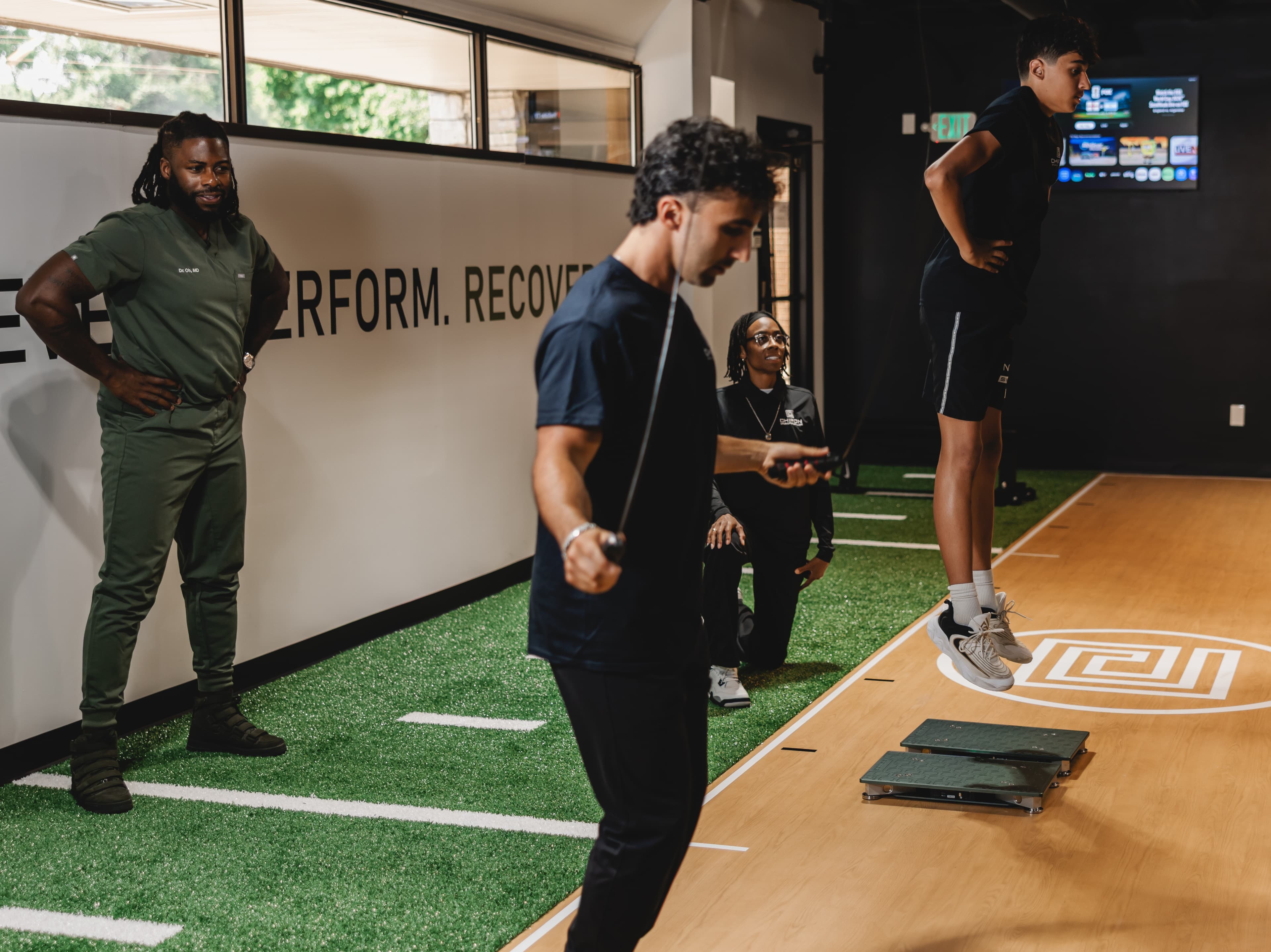
Measuring Explosiveness as Part of the Chiron Six
Power Testing for Athletes: Behind the Data
Power. A defensive lineman can squat 500lbs and still struggle to get past the player blocking him. Meanwhile, a much smaller basketball player might explode off the floor for a 35-inch vertical.
The lineman may be stronger.
But that doesn’t necessarily make him more powerful.
And this distinction is exactly why Chiron Sports Performance measures Power as one of the six pillars that make up the Athlete Blueprint in the Chiron Six.
“Strength is essentially, ‘Can you lift this?’” says Dr. Chibuzo “Casey” Ohanaja (Dr. Oh). “Power is asking, ‘Can I generate the force to do it within one second or two seconds?’ It’s how quickly you can generate force.”
In other words, Power measures explosiveness.
Why Power Matters
Think about what athletes are constantly being asked to do:
· Sprint
· Jump
· Cut
· Land
· Change direction
· Explode off the line
· Generate enough force, quickly enough, to beat an opponent to a space.
“When we think of athletes in different sports – changing directions, sprinting, landing – you have to be able to explode and generate force really quickly to be successful,” Dr. Oh says.
But Power can tell Chiron more than whether someone is explosive.
Dr. Oh says that metric can also provide information related to joint health, tissue health, and how the athlete’s nervous and muscular systems are responding to demands.
That makes Power not only useful for improving performance, but for understanding the athlete’s body more completely.
How Chiron Measures Power
At Chiron, one way Power is evaluated is through force-plate testing.
An athlete participates in a variety of exercises to measure their power, such as a counter movement jump, a single-leg jump, or another movement designed to show how quickly they can generate force against the ground.
Depending on the sport, Chiron can also evaluate power produced by individual limbs or the upper body.
The result is objective data showing something the human eye alone cannot measure.
“We can’t tell how much force they’re landing with or what the tissues are doing just by watching,” Dr. Oh says. “The data gives us an objective lens on what the naked eye can’t see.”
And that’s where Power becomes an interesting number.
Athletes are given raw metrics that show how various parts of their body are able to generate Power, as well as how that compares to other athletes of their age and size, and a plan for how they can improve their Power and measure the progress.
Each individual is unique, so each assessment has to dive into that athlete’s individual makeup.
A Low Power Number Doesn’t Automatically Mean “Get Stronger”
Suppose an athlete’s Power measurement comes back lower than expected.
“We have an athlete who is a high school football player, and we saw that his metric for power was a bit on the lower side,” Dr. Oh said. “But in the area of resilience, his hamstrings were really strong. So we told him that his hamstrings are a strength, and that we saw this as a development opportunity.”
The obvious answer here may seem simple: Get stronger.
But not necessarily.
“Get stronger is only one part of the equation,” says Dr. Oh.
An athlete may lack the necessary strength to generate more force. But another athlete could possess plenty of strength and simply lack the ability to activate those muscles quickly enough.
Both athletes could produce a low Power result.
“Power deficiency can come in multiple forms,” Dr. Oh says. “We’re able to tease that out by looking at the whole picture. If you have a power deficiency in your lower extremities, for example, we’re seeing that on your body composition analysis.”
Corrective measures could include power generation exercises such as squats, unilateral exercises, varying tempos, or other work targeted to what is actually limiting that athlete’s ability to produce power.
The Power number tells Chiron what’s happening.
The surrounding information helps explain why.
Power Can Also Become a Benchmark
Suppose Chiron establishes an athlete’s Power baseline when they’re healthy, only later to find out the athlete suffered an ACL, meniscus tear, or other injury.
Rehabilitation isn’t only about regaining basic strength. For an athlete who needs to jump, run, and change direction, the body eventually needs to regain its ability to tolerate and produce force quickly. Power testing can help show how that capacity is returning.
“As long as we see certain metrics that say they can respond to load quickly, that gives us an indication that the area that was injured can withstand that load,” Dr. Oh says.
Power doesn’t determine return-to-play on its own – but now Chiron has something objective to compare.
It’s not: Is the athlete getting better?
It’s: How does the athlete today compare with the athlete we measured before?
The Power Behind the Athlete
The goal isn’t to give an athlete another statistic, it’s to make that statistic useful.
A point guard struggling to finish on one side may discover a Power difference between the legs.
A football player who looks incredibly strong in the weight room may discover that strength isn’t translating into explosive force quickly enough on the field.
Another athlete may learn that Power is one of their biggest strengths and it’s worth continuing to develop.
For coaches, Chiron’s Power metric can be especially useful.
“I really value coaches,” Dr. Oh says. “They’re great leaders and mentors, and some are even parent-like. But coaches have so much on their plate, and a lot of them are skilled and have knowledge over time using their eyes. But the data is good at picking up things that aren’t apparent to the naked eye.”
That doesn’t make the coach less important. It gives the coach another tool.
“This data gives us objective, root-grounded information,” Dr. Oh says. “Otherwise, we’re guessing.”
And when it comes to an athlete’s body and performance, he’d rather know.
“We don’t want to guess with an athlete.”
That’s the value of going behind the data. At Chiron Sports Performance in Bloomfield Hills, Power becomes more than a measurement – it becomes information athletes, coaches, and the Chiron team can actually use. The result is elite performance for any athlete willing to do the work. If that athlete is you or someone you know, reach out to us at 248.321.4810 to get the process started.