What Body Composition Says About Your Performance
· Michelle Cohl
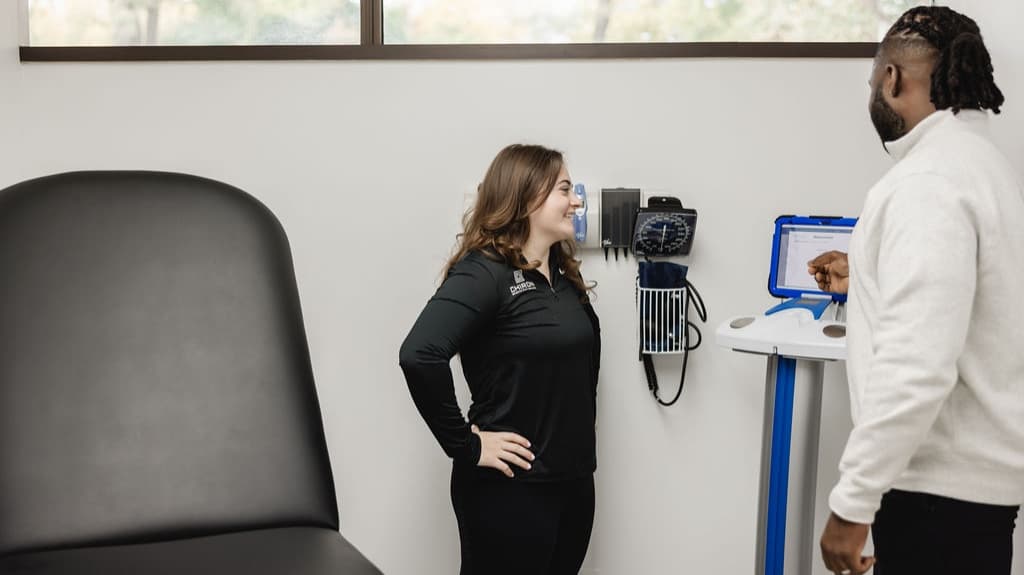
Body composition tells us more about athletic performance than height or weight alone.
At Chiron Sports Performance, it adds another layer of information to help athletes understand their bodies, guide training, and track recovery.
Forty years ago, Atlanta Hawks guard Spud Webb surprised everyone by competing in
the NBA Slam Dunk Contest during the league’s All-Star Game festivities in Dallas.
It was a surprise because Webb was 5’6, which led almost everyone to assume he
lacked the physical ability to dunk.
But not only could Webb dunk, he actually won the contest.
How is that possible?
It was possible because a player’s height only tells part of the story behind their
performance capability.
The rest comes from details like strength, tissue quality, cellular health, and muscle
mass.
Chiron Sports Performance examines all these factors through its body-composition
analysis.
Chiron co-founder and lead physician Dr. Chibuzo Casey Ohanaja (also known as Dr. Oh) said that if today’s body composition technology had been available to analyze
Webb during his playing career, the results likely would have explained some of what
made his athleticism so extraordinary.
“They would see that his phase angle (explained later in this article) is probably a lot
higher than the general population for his age,” Dr. Oh said. “Secondly, they would see
that his fat-free mass – an indication of his bones and his tendons – would probably
also be higher than the norm for his age.”
He would also expect to see especially strong phase angle measurements in Webb’s
left and right leg.
It’s a hypothetical example of a long-ago professional athlete, of course. But the
example illustrates a much larger point: What you see on the outside doesn’t
necessarily tell you what an athlete’s body can do.
Body Composition Is More Than Body Fat and Muscle
When most people hear “body composition,” they think of a scale that measures body-
fat percentage and muscle mass. And that’s certainly part of it. But at Chiron, body-
composition analysis goes much deeper.
Using the SOZO system, the Chiron team evaluates measurements related to
hydration, fluid inside and outside the cells, muscle and fat-free mass, tissue health, and
cellular function.
“People think of body composition like, ‘I’m going to stand on a scale that’s going to tell
me my fat percentage and my muscle mass, and that’s really it,’” Dr. Oh said. “It’s really
more complex than that.”
Body composition isn’t just used to tell whether an athlete is fit; its primary purpose is to
help understand how the athlete’s body functions – and how it responds to training,
recovery, nutrition, and workload.
Hydration Is a Performance Metric
One of the first things Dr. Oh looks at is hydration.
“If we see that your hydration level is low, I’ll have a conversation with an athlete about
that,” Dr. Oh said. “They usually don’t realize it can have such a severe impact on their
performance.”
That’s because hydration affects much more than how thirsty an athlete feels.
Muscles rely on fluid and electrolytes to contract efficiently.
And an athlete who is poorly hydrated may fatigue more quickly, cramp more easily, or
struggle to sustain a consistent level of output in a game or training session.
“If you’re dehydrated, you’re going to be at a higher risk for injury,” Dr. Oh said. “You’re
not going to be able to go as hard and as strong throughout the game. Your muscles
aren’t going to be able to contract as smoothly and efficiently.”
Consider a defensive back in football who needs to combine speed with high
endurance, sprint, cut, jump, and react repeatedly over the course of a game.
If that athlete begins cramping, grabbing at the hamstring, or losing the ability to keep
up late in the game, hydration is one of the factors worth examining.
“Hydration is a huge factor into overall performance within sports,” Dr. Oh said.
And hydration affects more than just a person’s muscles, too. It can also affect how you
feel and how well you stay focused.
For an athlete trying to read the field, follow an opponent, or make a quick decision late
in a game, dehydration makes those demands harder to manage.
The heart also depends on adequate fluid, which helps maintain blood volume that
carries oxygen to the muscles and helps the body release heat.
As you lose fluid through sweat, your heart may beat faster to maintain the same effort,
especially on a hot day.
The Chiron team looks at fluid measurements alongside how you’re feeling, your
medical history, and your performance testing. Together, that information shows what
you may need to adjust in your hydration, training, or recovery. The scan itself doesn’t
tell us how your brain is functioning or diagnose a heart condition, but it adds useful
information to the conversation.
The Fluid Inside and Outside of Your Cells Tells a Story
Chiron also looks at how fluid is distributed throughout the body.
Intracellular fluid is the fluid inside cells, while extracellular fluid is the fluid outside them.
These measurements show how an athletes body responds to training and recovery,
and whether intense activity is likely to cause inflammation.
If an athletes intracellular fluid is in a healthy range, Dr. Oh said it can support the idea
that the athletes body is responding well to training.
If extracellular fluid is elevated, it can indicate inflammation, edema, overtraining, or
poor recovery.
Once the results are clear, Dr. Oh gives athletes several action steps to improve the
measurements.
“If we find an inflammatory process that’s causing you to have high extracellular fluid, it
could be from overtraining,” Dr. Oh said. “But it could also be from what you’re eating, or
not recovering well.”
The analysis can also be broken down segmentally. If an athlete is experiencing pain or
recovery from an injury in one leg, the team can compare measurements on that side
with the opposite side and track how they change over time.
Phase Angle Offers Insight Into Cellular Health
Phase angle is one of the most important factors for athletes, and Dr. Oh pays close
attention to it.
Phase angle indicates cellular health by evaluating cell quality and function. It assesses
details like cell membrane integrity and fluid distribution in the body. It’s also considered
alongside other measurements like hydration, muscle mass, and injury status.
An athlete may have intracellular and extracellular fluid levels within the normal range
but show a lower phase angle. If that’s the case, that gives the Chiron team another
reason to look more closely at training load, recovery, sleep, nutrition, or injury status.
“One of the main things I want to look at is their phase angle,” Dr. Oh said. “Are their
cells healthy?”
Of course, none of these measurements are unchangeable. When working with
athletes, Dr. Oh and his team lead training regimens, but they also advise athletes on
their habits. They focus on details like protein and minerals. And they continue to
measure progress with further SOZO body composition analyses. This provides an
objective complement to any athlete who says they feel better.
Body Composition Changes Faster Than You Think
Body composition results aren’t fixed. Fluids inside and outside of the cells can change
within a day based on hydration, activity, sleep, stress, and nutrition.
Someone can train hard and eat well, but with poor sleep and lack of hydration, that
affects how the data shows up the next day.
“You taking care of your body with what you’re eating, how you’re sleeping, how you’re
recovering and how you’re training – all of those things are going to be factors in how
you’re going to develop over time,” Dr. Oh said.
Nutrition, sleep, recovery, hydration, and training all work together.
What Body Composition Means for Athletes
Professional sports teams are starting to learn about these tools and measurements.
For example, the Kansas City Chiefs use the SOZO device in their return-to-play
decisions for athletes recovering from injuries. It often shows the team something the
athlete's self-report would miss.
“Even if they’re going through their rehab and they’re feeling like they’re improving, we
might see that the phase angle is dropping,” Dr. Oh said. “That is an indication that your
cells aren’t ready for the demand of returning to play. That’s one of the key factors we
look at here at Chiron.”
Teams can address many of these issues with simple measures, like giving a
dehydrated athlete an electrolyte package before or during the game. This is why World
Cup soccer now incorporates hydration breaks into matches.
Connecting Body Composition to Performance
And consider again the example of a defensive back.
The athlete needs speed, endurance, explosiveness, and the ability to quickly react
throughout the game.
If that athlete experiences hamstring tightness, cramps, or shin pain, body composition
helps provide another layer of information.
“We can start off with the hydration index,” Dr. Oh says.
The team can then look at the skeletal muscle mass and fat-free mass, which helps
provide information about the tissues the athlete relies on to sprint, cut, jump, and land.
Using Body Composition to Track Recovery
At Chiron, the team starts off establishing a baseline and then retests the athlete
throughout rehabilitation.
For instance, if an injured leg has lost muscle mass, later scans can help determine
what tissue is rebuilding.
If cellular-health measurements aren’t moving in the right direction, that’s another
reason to reconsider workload or recovery.
Dr. Oh says these measurements become especially valuable when combined with
what the team sees during performance testing.
“If we’re seeing certain things here, especially with the segmental breakdown, we can
see that when we’re doing the performance test out there,” he said. “The numbers don’t
lie.”
Dr. Oh encourages teams to be proactive at every level, especially for younger athletes
in the development phase of their careers.
Body Composition and the Chiron Six
Body composition doesn’t exist separately from what an athlete does on the court, field,
or ice. At Chiron, all this information is tied into the Chiron Six.
Hydration can affect readiness.
Cellular and tissue health can inform resilience.
Healthy soft tissue can support elasticity and power.
“When we look at cellular fitness in relation to resilience and tissue capacity, we tie it
into other performance metrics like elasticity in terms of their tendons and how springy a
person can be,” Dr. Oh said. “And hydration relates to readiness, because if their
intercellular fluid is high, we know that’s going to support their power metric and their
control metric, as well as their elasticity and their resilience metric.”
Differences between body segments also give the team another way to understand
control and movement.
“It’s all tied,” Dr. Oh adds. “It’s multiple pieces of the puzzle that get put together and tell
the athlete their roadmap.”
That’s why Chiron doesn’t use body-composition analysis to just tell an athlete what
they weigh. It uses that information to ask the best question of all: What does your body
need to perform at its best?
The SOZO body-composition analysis is one component of Chiron’s method –
combining objective data with performance testing to identify athletes strengths,
limitations, and opportunities for growth.
Click here to learn more.