Soreness vs. Injury Pain: How to Tell the Difference
· Michelle Cohl
Knowing the Difference Between Soreness and Pain That Could Signal Injury
We’ve all heard the phrase, “No pain, no gain.”
It’s meant to suggest that getting stronger, faster, or more fit, requires you to push yourself physically.
And Chiron Sports Performance co-founder and lead physician Dr. Chibuzo Casey Ohanaja (“Dr. Oh”) has a response to that familiar alleged wisdom:
“Pain does not equal gain.”
Athletes need to understand what their bodies are telling them, because there’s an important difference between soreness that naturally follows training, and pain that deserves a closer look.
Soreness Has a Pattern
Soreness is common when athletes begin a new training program, increase their workload, or introduce the body to a different method.
“Soreness is something that, especially with training, can happen frequently,” Dr. Oh said. “That’s the body’s way of adapting to new stimulus. But there will be a peak in the soreness, and then it gradually dissipates.”
Normal soreness – once it develops – reaches a peak, improves as the body adapts, and then recovers. Not every soreness, though, should be ignored. Sometimes when soreness becomes significant enough, it indicates that an athlete has taken on more load than the body was ready to handle, and training needs to be adjusted.
But typically, soreness will move toward improvement.
Pain that repeatedly returns, persists, or comes with other symptoms, on the other hand, is different.
When Pain Deserves More Attention
Pain becomes a concern when it’s accompanied by the following symptoms:
· Persistent or recurring swelling
· Numbness or tingling
· Weakness
· Instability
· A joint giving out
· Loss of strength or power
· Difficulty performing movements the athlete could previously complete.
This is important, because athletes (especially competitive ones) become very good at tolerating discomfort.
Being able to play through something doesn’t mean that the body is functioning normally.
There are, however, circumstances in sports rehabilitation where a limited amount of discomfort is acceptable.
Dr. Oh says clinicians sometimes allow an athlete to work through mild pain, around a 4-out-of-10 on the pain scale, when performing certain rehabilitation exercises. This is designed to restore function.
But once that pain exceeds an acceptable threshold, persists, or affects functionality, the best response is to adjust the workload and investigate why it’s happening.
Learning How to Describe Pain
Anyone who has been asked by a physician to describe their pain knows this can be surprisingly difficult. That’s why one of the most useful skills an athlete can develop is learning how to explain what they’re feeling.
To that end, Dr. Oh offers a set of examples for types of pain words athletes can choose. And these words provide useful clues:
Pins and needles. This can suggest possible nerve involvement.
Sharp or stabbing. This tends to signal acute trauma, irritation, or inflammation and deserves attention, especially when it begins suddenly.
Dull or aching. This describes a different pain pattern and can help clinicians narrow down possible causes.
Hot or warm. Warmth combined with swelling or other symptoms may prompt a physician to consider inflammation or, in some circumstances, indicate infection.
Radiating. Pain that travels from one part of the body to another suggests that the source is somewhere other than the location where the athlete feels it.
Clinicians also find it helpful to know how the pain behaves. Did it begin suddenly or gradually? Does it recur? Does it travel? Is there swelling? Does the joint give out or lock up? Has the athlete lost strength, mobility, or function?
“The more details we can tease out, the better we can understand what may be going on,” Dr. Oh says.
The Body Warns You Before a Bigger Problem Occurs
Weakness is an important piece of the puzzle that clues us into something deeper developing.
“If I’m having issues firing my quad – every time I’m trying to jump off one foot and I just can’t generate enough power and the quad’s giving out – the next thing that comes could be the Achilles,” Dr. Oh said. “We’ve seen this a lot, especially in the last few years within the NFL and the NBA.”
The concern lies when one area is no longer producing or absorbing force the way it should – that’s when other muscle groups take on the load. When that happens, it changes how an athlete runs, jumps, lands or absorbs force.
Professional basketball has shown us some reminders of how devastating non-contact injuries can be. Indiana Pacers guard Tyrese Halliburton tore his Achilles during the 2025 NBA Finals after playing through a calf strain earlier in the series and subsequently missed the entire 2025-2026 NBA season. Sacramento Kings guard Ben Simmons tore his Achilles during practice before the 2026-2027 season.
These examples do not mean that every calf problem or weakness will result in an Achillies injury, but they do highlight why changes in strength, function, or recurring symptoms shouldn’t be dismissed.
“It’s unfortunate that we’re seeing all these different types of musculoskeletal injuries that are non-contact,” Dr. Oh said. “But there are tell-tale signs that you’re at risk for them. When the athletes themselves are feeling certain things, they need to make sure they’re looking at it.”
Some Symptoms Are Red Flags
Certain combinations of symptoms warrant immediate medical attention:
· Back pain accompanied by bowel or urinary dysfunction, or numbness around the pelvic region, requires immediate medical evaluation.
· Pain radiating from the lower back down the leg can indicate nerve involvement originating in the spine.
· Neck pain that travels into the shoulder or arm accompanied by numbness or tingling could mean a damaged nerve or disk.
· In the knee, instability and repeated giving-way or swelling signals something more than normal post-training soreness.
Musculoskeletal weakness is often a sign of a structural issue that could be emerging.
There are more examples, of course, but the key isn’t for athletes or parents to diagnose those conditions themselves. It’s to recognize when the symptoms have moved beyond the category of ordinary soreness to needing an evaluation.
When ‘Playing Through It’ Stops Working
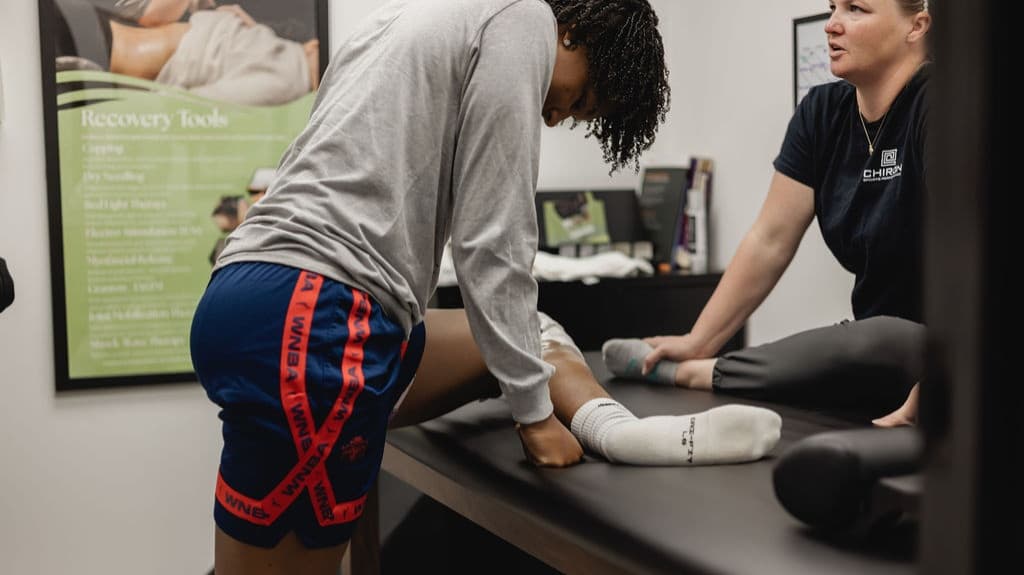
Chiron member athlete Kamaria McDaniel is a great example of why playing through pain isn’t the solution.
As a professional basketball player with a high pain tolerance, Kamaria became accustomed to playing through her discomfort, but eventually the problem was no longer just her knees that were sore.
She noticed every day that her athletic function was changing. She had to walk down the stairs sideways, her knees would give out, and training became increasingly difficult.
These symptoms led the Chiron team to investigate further – and her story is one of success. We encourage you to read it here.
Parents: What Should You Do?
Dr. Oh urges parents of young athletes to ask their children better questions on a weekly basis. Questions like:
· Where are you sore?
· When did it start?
· Does it improve after rest?
· Does it come back every practice or game?
· Is anything making it worse?
· Are you changing the way you run, jump, or move because of it?
“Pushing through the pain might get them onto the field,” Dr. Oh said. “But in the long run, it may put them at more risk for injury and damage their careers over time. So really, try to make sure you get them to understand their symptoms.”
And then share what you learn with someone who can help, whether that person is an athletic trainer, physician, or a coach.
Pain Does Not Equal Gain
Athletes should expect fluctuations in how their bodies feel.
Training will produce soreness, and hard work should feel like hard work. But once persistent pain emerges, that’s information.
The earlier an athlete learns to recognize and communicate what they feel, the better the chance for their coaches and medical providers to respond appropriately.
Don’t just train harder. Understand what your body can handle.
Chiron’s Athlete Blueprint will give athletes an objective look at their body’s strength, limitations, and opportunities for growth. If you’re interested in learning more about how your body responds to training, workload, and recovery, start your journey here.